
The Outgoing TUMS Chancellor Endorses His Successor
TUMSPR News: The outgoing TUMS Chancellor, Dr. Mohammadreza Mansouri, endorsed his successor, Dr. Ali Jafarian in a meeting attended by the Health Mininister, and authorities and faculties of the University on September 23, 2013.
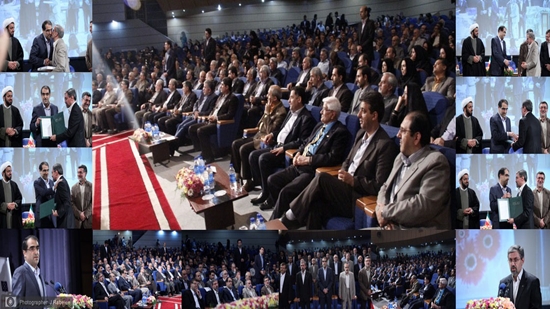
On the first day of Academic Year 2013, the outgoing Chancellor of Tehran University of Medical Sciences (TUMS), Dr. Mohammadreza Mansouri, endorsed his successor, Dr. Ali Jafarian in a meeting attended by the Health Mininister, and authorities, faculties, staff and students of the University on September 23, 2013.
 Head of TUMS Public Relations, Dr. Seyed Mansour Gatmiri, delivered the opening speech. Commemorating the Sacred Defense Week, Gatmiri said Iranians owed the peace and security in the country, in contrast to other countries in the region, to the martyers who defended Iran against foreign invasion during the Iran-Iraq War.
On the opening of the New Acaemic Year, he said learning science was the prerequisite to scientific leap. He also thanked Dr. Mansouri for leading the University in one of its hardest times and preventing it from probable negative impacts [due to chain of events following the resignation of its chancellor, Dr. Bagher Larijani].
Gatmiri also welcomed the newly appointed chancellor Dr. Ali Jafarian and wished he would be successful during his  term.
term.
Thanking the outgoing chancellor, Dr. Mansouri, for leading the University during a tense time, Dr. Moslem Bahadori, the Head of TUMS Alumni Office, evaluated the appointment of Dr. Jafarian positively and said by his wisdom, patience and respect for equity and justice he could lead the University to growth and prosperity.
Stating that TUMS was regarded as a mother institute, he said it had two missions to accomplish one, moving in the frontiers of knowledge, and two, maintaining the health of the society. He assured the institute had been successful in both but it had to conclude its current projects and venture into grass root activities for maintaining an innovative atmosphere.
 Dr. Issazadeh, the Head of supreme leader’s office in the tehran university of medical sciences, emphasized on the quality of one’s convictions during his life than longevity alone and said we could also develop a “pure existence” alongside the material world. He said accepting the responsibility by Dr. Mansouri in those days was not for worldly position except for a selfless service to the university.
Dr. Bagher Larijani, the former TUMS Chancellor, also commeemorated the Sacred Defense Week and opening of the New Academic Year 2013. Calling the University a valuable constellation with more than 1000 graduates each year, Larijani pointed out that 75 percent of the top 100 students who take the national enterance exam choose this university to be inspired by the most distinguished professors.
Saying that the time has changed dramatically compared to the time when TUMS was the only medical university in the country, the Head of TUMS Medical Ethics Research Center said the University had to be competitive and excel among more than 50 similar institutions. Nevertheless, the University is producing more than 30 percent of the scholarly articles [in the field of medicine and allied health], he said, and quite many new fields of study originate in this university and it has been the source of policy change in the health sector. In other words, he explained, TUMS is in some way, the R & D of medicine in the country and we have to keep this position and even promote it.
Saying that gusts of [unfriendly] wind have blown to the university from time to time, Larijani said, but the managers of the institution have wisely managed them and tried to keep its integrity and use the opportunity to advance it. Moreover, he said, the university has been able to recognize the space of time and situation and [analyze] the directions given by the state authoritis [to clearly pursue its goals] and move forward. He then introduced a book authored by him titled “The Way to the Future; the Report of Ten Years of Development in TUMS”, and presented a copy of the book to Dr. Jafarian (onstage) and also to the Minister of Health.
On the appointment of the incoming Chancellor, Larijani said Dr. Jafarian was fortunately familiar with the nuts and bolts of the university for the past eight years and thanked him on behalf of all the attendees to shoulder the responsibility despite his scientific pursuits. He also thanked Dr. Mansourian for accepting the responsibility nearly seven months ago and hoped he could shine as before in other parts of the university.
 Congratulating the New Academic Year and the Sacred Week of Defense, Dr. Mansouri, the outgoing Chancellor, said students choose this world-class university for good reason and we have to keep this reputation.
On the international achievements of TUMS, Mansouri said the University had obtained accreditation [from one of the most prestigious institutes in Europe] and it had kept its lead in the country in different education and research festivals and even its world rank by the help of its faculties, students and staff.
On challenges during his term as the chancellor, he said he had encountered tensions in the university, such as disintegration of Iran University of Medical Sciences (IUMS) and calls for its reinstitution. However, he said, he had overcome them by consultations till the Supreme Council for Cultural Revolution voted for IUMS reinstitution on his last day in office. He finally thanked each faculty and staff for their sincere contribution.
 Dr. Ali Jafarian also took the podium to congratulate the New Academic Year and the Sacred Defense Week.
On the history of TUMS he said the University in its more than 160 years of existance, had been established in Dar ul-Funun in 1851 and relocated into the current premises of University of Tehran (UT) in 1934. The Faculty of Medicine and other related health sciences later formed TUMS after separaton from the Ministry of Sciences in 1986. Since 1986, the year he entered UT as a medical student, he had witnessed the growth and independence of TUMS in the past 40 years, starting from the term of the late, Dr. Mohammad-Hassan Bastan-Hagh, the First Chancellor, to that of Dr. Mohammadreza Zafarghandi and later Dr. Bagher Larijani and finally Dr. Mohammadreza Mansouri.
On the achievements of former chancellors of TUMS, Jafarian said each had had both great achivements and failures and this is the inevitable fate of all who undertake administrative tasks, but he said one had to be careful to keep the mistakes at a minimum.
On the status of TUMS, Jafarian said the University had both weaknesses and strengths. For instance, he said, the University was robust in its structure or had earned a national reputation, or had great staff and top students. On the other hand, he said, the University was too large to have the needed agility to perform certain menouvers or some of its schools and hospitals were rather old, 49 years on the average, and in need of renovation or reconstruction that needed hefty budgets. Sina Hospital, for instance, is 96 years old but Tehran Heart Center is 13. He concluded that despite vast human resources, and skills and abundance of ideas, resource shortages were major drawbacks.
Indicating the social peace and the emphasis on widom and hope, Jafarian said we should use the opportunity to exploit all capablities and views in [the management of] the University and refrain from conflict and events that have no originality but are time-consuming and unproductive, instead, to advance the University in the desired direction.
On his programs, Jafarian said respecting each other was the first step to be institutionalized in the University to produce a cultural transformation within the institution. He finally said the University belonged to all TUMS employees and students and no change was possible without the collective cooperation among its members as the driving force of TUMS was not its executive authoritis.
 Handing apprectation plaques to Dr. Mansouri and the appointment decree to Dr. Jafarian, Dr. Hassan Hashemi, the Health Minister, said a young, distinguished professor was taking the great responsibility to lead the most resourceful university in the country.
On the importance of learning science, the Minister said if anything was more important, the first verse that was revealed to the Prophet was a verse other than commanding him to recite the first lines of (chapter 96 of) the Quran. That was why science and scholars were valued so high in Islamic societies, the Minister said. Without any doubt, he said, one of the old [scholastic] systems was based on the concept of superstition and the other on a scholarly system without morals. However, he left the judgement to the participants to determine where they were standing on this evolutionary path.
Saying that despite all the tools and facilities, opportunities had been lost in recent years he said the cultural obligations of a country that has undergone a revolution deserved to provide equal opportunities for all to think and reprimand [openly].
Hashemi also said universities were to have a vibrant, lively and political atmosphere and a cradle for freethinking, as proposed by Iran’s both past and present leaders. Hinting at the common freethinking discourses held in universities, the Minister said they were more formal than substantive; therefore, he had emphasized on the importance of the idea to the vice-chancellors of education and student affairs, considering the status of the country after the last presidential election.
The Minister also said it was rather impossible for a country to be strong without having vibrant universities. On the other hand, he said in some points in history, scholars had unwanedly served as agents of political parties and groups. Emphasizing on the need for political thinking in universities, the Minister cautioned about political exploitation of scholars.
Praizing the ethical values of Dr. ansouri, the Minister said he was ethically his desciple and the decision to accept his resignation was one of the most difficult ones but taking into account Dr. Mansouri’s and the university’s interests he had been convinced to do so.
Highlighting on the need to exploit the expertise of distinguished professors and employ young and daring faculties he said one should not assume that the university was doing well as expected but it needed young and daring people to besuccessful.
Finally, he said, it was a decisive period since the golden years of selling oil had been left behind and the universities were in need of competent managers who could accomplish great jobs in hard times.
Photo galleries 1,2, 3, 4,5, 6, and 7.

ارسال به دوستان